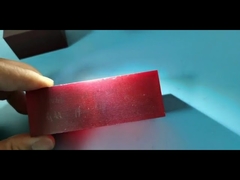
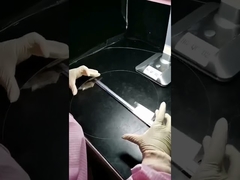
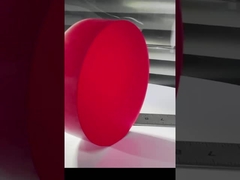
Σύνοψη: We show the practical steps and results so you can judge suitability quickly. This video demonstrates the manufacturing process and performance testing of Customized Ruby Jewel Bearings (Al₂O₃), showcasing their ultra-precision grinding and optical-grade polishing techniques. You'll see how these bearings deliver exceptional wear resistance and low friction in precision instruments and watch movements.
Σχετικά χαρακτηριστικά προϊόντων:
Manufactured from synthetic corundum (Al₂O₃) doped with chromium for exceptional hardness and low friction characteristics.
Features Mohs hardness of 9 and surface roughness Ra < 0.3 nm through optical-grade polishing.
Operates across extreme temperature ranges from -200°C to +800°C with high dimensional stability.
Provides corrosion resistance against acids, alkalis, oxidation, and moisture for harsh environments.
Available in multiple precision geometries including spherical, conical, straight-hole, and ring-type bearings.
Supports customization with OD range 0.8-10 mm, height 0.6-5 mm, and bore diameter 0.05-3 mm.
Enables lubrication-free operation due to ultra-smooth crystal structure and minimal frictional loss.
Ideal for precision instruments, watch movements, aerospace navigation, and medical equipment applications.
FAQS:
Why is ruby used for precision bearings?
Ruby provides extremely low friction, exceptional wear resistance, and long-term dimensional stability, making it far superior to metal bearings for precision applications.
Do ruby bearings require lubrication?
In many applications, no lubrication is required because the polished crystal structure provides natural low-friction performance.
Are ruby and sapphire bearings the same?
Yes, both are Al₂O₃ single crystals. Ruby contains chromium which gives it a red color, while sapphire is typically clear or blue.
Can ruby bearings work in harsh environments?
Yes, they resist acids, alkalis, high temperature, humidity, and vibration, making them suitable for demanding applications.
Are jewel bearings suitable for high-speed micro-rotation?
Yes, their low friction and micro-scale precision make them ideal for watch escapements, micro-motors, and sensitive instruments requiring high-speed rotation.